Lucy Kowalchuk adjusted her webcam to take in as much of her class as possible.
“Jordan, move in a bit.”
Jordan scraped his desk across the floor until he was a little closer to his classmates. Miss Kowalchuk checked her laptop screen and saw that the entire class was now in the field of view, even if Jordan was just leaning into it.
“Okay, everyone. We’re almost ready. Now we just have to wait for mission control to connect us with Commander Clements.”
The buzz in the classroom rose gradually as they waited. It wouldn’t be the first time a Grade Six class had a webcam meeting with the commander of the International Space Station, but it was exciting nonetheless. Dale Clements was continuing the recent trend of celebrity astronauts, fostering interest in space exploration among the general public, and grade school students in particular. The fact that he was born in Manitoba made it doubly exciting for the students in Miss Kowalchuk’s class at Henderson Elementary.
Miss Kowalchuk sent the video from her laptop onto the big screen at the front of the class, then clicked on the button to enter the meeting. An official but Earthbound face appeared.
“Miss Kowalchuk? I’m Chuck Bradley at Mission Control. We’ll be hooking you up to the ISS in a few minutes. Can I say a few words to your class?”
Miss Kowalchuk stepped aside, bringing her class back into the camera’s view.
“Good morning, everyone. Just a few things to be aware of when you’re talking to Dale. Because of the way our radio signal works, there is a bit of a delay between when you talk and when he talks. For a second or so it might look like he hasn’t heard you, but be patient; no need to repeat yourself. Also, you can speak normally; no need to shout your questions. I know Miss Kowalchuk has probably talked to you about this, but try to make your questions as thoughtful as possible. Sometimes people ask about aliens and space dogfights, but science questions are a much better use of your time. We don’t battle space aliens out there, but we conduct a lot of scientific research.”
Bradley paused and looked at something off-camera. “Okay, everyone, Dale is ready. Here you go; enjoy your meeting!”
The image on the screen changed and Miss Kowalchuk saw the smiling face of Dale Clements, upside-down in the control room of the International Space Station.
“Hi everyone!” he said. “Don’t tell me Dauphin turned upside-down this morning?”
Most of the class chuckled as Clements turned a zero-gravity somersault, ending up right-side-up on their screen.
“That’s better. Greetings from space! I’ve been talking to Miss Kowalchuk by email, and she tells me that you’ve been studying my current experiments. So I think we’ll get right to your questions so we can make the most of our time. What would you like to know?”
Half a dozen hands went up around the class.
“Britney,” said Miss Kowalchuk.
“Mr. Clements? I have a question? About your bacterial irradiation experiment? How do you make sure the bacteria? Get the exact type of radiation you want them to get.”
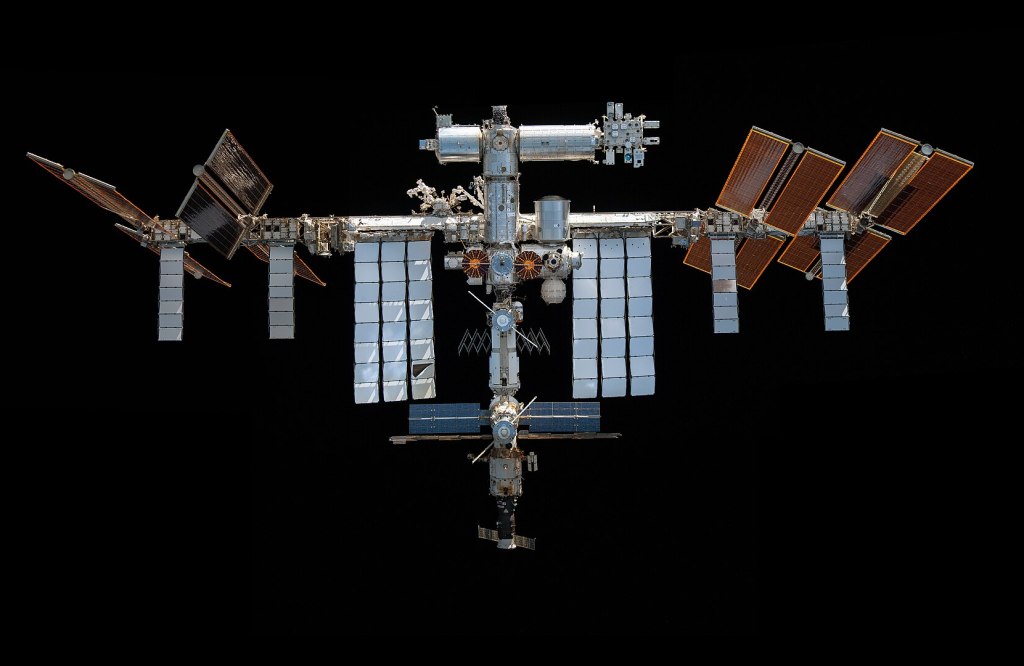
“That’s a very good question, Britney. Let me show you the pod where that experiment is done.” On the screen, Clements shrank into the corner, and an outside view of the station filled the main viewing area. “On the edge of this module you can see the experimental pod. It’s connected to the inside of the module to supply oxygen, water, and the other essentials the bacterial cultures need. The outside of the pod is made of glass with a bit of lead in it, so it filters out the exact amount of high-energy radiation we want. In addition to that, there is a precise thickness of water around the bacterial samples to filter out lower-energy radiation.”
Clements’ image came back to the main screen, relegating the outside view to the corner. “Next question…”
More hands went up.
“Dave,” said Miss Kowalchuk.
“Is it true that you drink water that gets recycled from pi—I mean, urine?”
The class laughed.
“All of the water on the ISS is recycled,” said Clements. “Wastewater from washing and from biological activity is processed through a special filtration system that includes reverse osmosis and UV radiation to make sure it’s as pure as possible. It’s really not much different from the water you drink. Dauphin gets its drinking water from a river, doesn’t it?”
“The Vermillion River,” said Miss Kowalchuk.
“Well, how many animals do you think pee in that river before it reaches Dauphin?”
There was a chorus of “Eww!” from the class, and a few chuckles.
“But it goes through a water treatment plant that cleans and disinfects it before sending it through pipes to your house. On the ISS, the treatment equipment and pipes have to be much smaller, but it’s the same idea.”
“Hey, what’s that?” asked Kelsey, pointing to the bottom corner of the screen, which still showed the outside view.
Clements looked down in front of him. “Hmm,” he said. “I’m not sure what that is. Let’s take a closer look.”
Clements’ image went to the bottom corner of the screen, and the outside view took its place.
“It seems to be some kind of unidentified object,” said Clements.
There was a groan from the back of the class, and a few chuckles from other students. The object on the screen was disc-shaped, with a bulge in the middle. Lights flashed around the edge.
“Did we have to have this meeting on April first?” asked Perry.
“The object is coming closer,” said Clements. “According to radar, it’s about sixty feet across. It appears to be made of metal.”
“Oh, come on, Dale, really?” said Perry.
“Perry!” said Miss Kowalchuk. “Just get into the spirit of it, will you?”
“But it’s lame!” said Perry. “If it was old school, you’d be able to see the wires.”
“I’m receiving a signal from the object,” said Clements. “It says…”
“If he says ‘we come in peace,’ I’m outa here,” said Perry.
“…’We mean you no harm,’” said Clements.
“Same diff,” said Perry. He slumped his head down onto his desk. “Wake me when this is over.”
“According to the message, they call themselves the Sloof Lirpa. They see that humanity has made some mistakes about respecting their planet, and want all young humans to help spread the message that they need to take better care of their world.”
“What happens to us if we don’t?” asked Keri.
A rubbery, green face entered the webcam’s field of view. “Then we’ll be really, really mad!” it said.
There were a few shrieks around the class, followed by laughter.
“Boogedy-boogedy!” said the second astronaut before taking off his mask.
Even Perry laughed. “Okay, guys. The first bit was still pretty lame, but the mask made up for it.”
“Let’s give a round of applause for Hart Jackson, our mission specialist,” said Clements as his erstwhile alien pal perched beside him.
“Didn’t it cost you? Extra money? To bring that mask up there?” asked Britney.
“Another good question,” said Clements. “Now that the Dragon launch capsule is fully operational, it costs approximately $5000 to bring each kilogram of payload up here. This rubber mask weighs about fifty grams—”
“You mean that’s its mass,” interrupted Andrew. “It doesn’t weigh anything up there.”
“Good catch,” said Clements. “You’re exactly right. Its mass is about fifty grams, so it cost us about two hundred and fifty bucks to bring it up here.”
“We spare no expense to bring you the most immersive April Fools experience possible,” said Jackson.
“Is that part of it too?” asked Kelsey, pointing to the bottom of the screen, where a new object had entered the outside view.
Both astronauts looked at their viewer, then immediately flew off to the nearest window.
“What the hell?” said Clements. “Hart, get Houston.” He came back to rest in front of the camera. “Sorry, kids. We’ll have to cut this short.”
The camera view went dark, flickered back on briefly, then went dark again to a chorus of “Aww” from the class. Miss Kowalchuk was about to click out of the meeting when the picture returned. Jackson was off to the side, trying to reach mission control on the radio. Clements was sitting very close to the camera, looking down to the side.
“It’s bigger than the ISS!” Clements said. “But the radar signature is tiny.”
“Houston!” Jackson shouted. He turned around suddenly. “Holy shit!”
There was a gasp from the class. On the screen, an object floated into view behind Clements, who was still focused on whatever instruments were in front of him. Jackson tried to retreat back into his control panel as the object approached him. The object turned and disappeared from view behind Clements.
The class watched as Dale Clements’ face turned into the strangest smile they had ever seen immediately before his head melted down into his space suit like a deflating basketball.
There was a moment of shocked silence, then everyone in the class screamed.
“It appears that Dralt-thirteen is not the proper preservative,” said Captain Zander. “What does this tell us about this species?”
A number of blue hands raised around the classroom.
“Belti,” said Miss Proskil.
“They use iron in their blood to transport oxygen for cellular respiration?”
“Very good!” said Zander. “So what preservative should we try on the other individual?”
“Ontol-five!” said three students at the same time.
“Exactly. Let’s push a dose to the other one now.”
Zander’s image was reduced to the lower corner of the screen, switching places with the view inside the alien capsule. The probe moved in and delivered its dose, despite the alien’s attempts to crawl through the wall behind it. The alien went limp, but remained whole.
“Perfect,” said Zander. “Now we’ll bring it on board. There are three more aliens on board the capsule, but we’ll leave them be. Someday, this species may become intelligent. I wonder what their history will remember of this event.”
“How do you know they’re not intelligent already?” asked Proot.
Zander chuckled. “You haven’t been paying attention to Miss Proskil, have you? They’ve allowed their atmospheric carbon dioxide to top four hundred parts per million. Can you imagine an intelligent species letting that happen?”
“Okay, call me stupid,” said Proot.
“Maybe they are intelligent? but just aren’t paying attention?” said Briss.
“You mean they’re a whole world of Proots?” asked Jant.
The class laughed.
Zander laughed along with them at the absurdity of the suggestion. He marveled once again at what a great teaching tool these Mooz meetings were.
Afterword
I originally used Google Hangouts as the online meeting platform in this story, but Google has changed the name of that application a couple of times since then. Zoom seems to be a little more consistent.
Copyright 2013 by Violet Beckingham, all rights reserved
 I Am Violet