One of the coping suggestions in SGW this morning reminded me of something that happened to me on Saturday night. That was the day I went to the opera. It was a day to remember, in more ways than I expected.

One of the coping suggestions in SGW this morning reminded me of something that happened to me on Saturday night. That was the day I went to the opera. It was a day to remember, in more ways than I expected.
I was talking to my best friend on the weekend.(1) We were talking about smiling, and how it comes through when you really feel it. I sent her this picture, which was taken on April 16, 2023.

I took that picture shortly after dying my hair purple for the first time, three and a half months before my awakening.(2) That’s about as brightly as I ever smiled in my selfies before I transitioned. Just now I was looking for a selfie taken just before I transitioned, but I don’t have one. The closest one I have was taken in May.
I never used to take a lot of pictures of myself. I created a folder for my selfies in late November because I had started taking a lot more. I went back two years to find old selfies. My new folder contained 19 selfies taken in the two years before I transitioned, and 91 taken in the four months since. As of today (January 29), that folder has 227 pictures in it.
This is a common pattern among transgender people. When you start loving yourself, you take more selfies. A lot more. This one is my favorite:

This picture was taken on January 6 by the person who had just pierced my ears. In 54 years, this was the first time I had gotten a piercing. I was happy. My piercing artist was very affirming. She had just said something that made me smile, and she took three pictures in short succession.
For days, I couldn’t stop looking at this picture. I had smiled before transitioning, of course. I had been happy once in a while. I had smiled specifically for pictures. I smiled when my son was born, and when I got married. But I had never smiled like I did in this picture.
Immediately after leaving the studio, I sent this pic to a bunch of friends. I received replies throughout the day. Everyone said I looked great. I looked so happy. My sister said she had never seen that smile before.
When I got home, I started changing the profile pictures on all of my online accounts to this selfie. I had never loved a picture of myself so much. Before transitioning, I had never loved a picture of myself at all.
This picture is me.
So who was in the previous picture? I looked at the first picture again this morning, and I didn’t recognize myself. It’s me, but not me.
At the most fundamental level, of course I’m the same person. I’ve retained a lot of my thought processes and some of my behavior patterns. But I feel different. I express myself differently. I interact with others differently. And I look different. Part of that is three months of hormone treatment, but more of it results from how I feel about myself since I figured out who I am. Before transitioning, I didn’t look in the mirror much. When I did, I was looking at something specific, not at my face overall. Now I look into the mirror and I see myself.
Look at both pictures again. They’re not the same person. The first picture is a shell I used to hide behind. Me, but not me. The second picture is me.
(1) With this friend, that’s like saying the sky is blue, water is wet, etc., but I have to set the scene for this paragraph.
(2) But there were no signs!
Mastodon is my primary social media. It’s run independently, so it’s not subject to the whims of anonymous shareholders or a flaky owner. It consists of thousands of independent servers that talk to each other. A lot of scientists and tech people use it.
I was scrolling through my feed the other day when I came across this thread. It’s written by a biologist who studies how certain gene sequences regulate the expression of other genes. He explains the complex process of how sex is determined in a very simple, accessible way.
If you’ve wondered how biological processes can produce trans and gender diverse individuals, here’s a quick and easy explanation.
I want to rescue this from my account on the birdsite but I once got into arguing with TERFs (it happens, try not to judge me too harshly) and as a biologist I just wanted to push back a little on the “it’s just biology” line, so I wrote the following:
Okay, sex determination in humans.
This shit is COMPLICATED and this will probably be a longish thread. Sorry. But I’ve seen a lot of people claim that “biology says” that everyone is either male or female, full stop, and it’s just not true. 1/22
So human fertilized eggs develop into embryos with a pair of “indeterminate gonads” and TWO full sets of tubes. The Wolffian ducts can develop into the epididymis (omg spelled FROM MEMORY) & vas deferens, and the Müllerian ducts can develop into uterus and fallopian tubes. 2/22
Most embryos that get a Y chromosome will have a working copy of a gene called SRY (for Sex-determining Region on the Y). The product of the SRY gene is a protein that can control when other genes are turned on. If the cells of a gonad start making working SRY protein … 3/22
… then they start to develop into a testis. Some of those cells produce high levels of testosterone, and some make a protein called Müllerian-Inhibiting Substance. The Wolffian ducts need high testosterone to survive and develop; Müllerian ducts do by default UNLESS … 4/22
… MIS is around to stop them. So SRY can coordinate a program that shunts the default female development into male development.
Chromosomes can break and pieces can rearrange, so some people get a Y chromosome without an SRY gene, and are usually seen as female at birth. 5/22
Humans didn’t evolve to have Y chromosomes in the females, or only 1 X, so these people generally have abnormal sexual development and tend not to be fertile. Likewise, the rearrangement can mean that SRY winds up on another chromosome, so someone can be XX and “male.” 6/22
Without some other genes on the Y chromosome, and with 2 Xs, these people do not exactly develop the “normal” male program.
But it’s a LOT more complicated that that, even. 7/22
I was careful to say “a working copy” of SRY above, because genes mutate sometimes. A change of a single DNA “letter” (out of >800) can make a completely broken protein that’s like not having an SRY gene at all. OR, it can make a partially changed protein. 8/22
SRY controls a lot of things, so a partial change in the protein can mean activation of some crazy subset of the genetic program it normally activates. The result is an embryo not really developing as male, exactly, or as female, exactly. 9/22
Consider, too, that the enzymes that make testosterone are made from genes (controlled by SRY) different from the gene for MIS. One of those and not the other can be broken, and you can develop with unusual combinations of Wollfian/Müllerian duct products. 10/22
And just like SRY, the enzymes that make testosterone can be partially changed, and you can make intermediate levels, that don’t exactly direct male development but don’t exactly direct female development either. 11/22
For other parts of the body to become “male” or “female,” they have to respond to these signals. That early embryo has tissues that can either become a penis and scrotum or a clitoris and labia. Mostly the difference is in how much testosterone they see. 12/22
But responding to it requires another protein that controls other genes, this one called the Androgen Receptor. People with AR mutations can be XY with a working SRY gene, but will generally be viewed as female because their cells don’t know that testosterone is high. 13/22
At puberty, lots of other cells become responsive to these signals. Breasts and beards may develop. When different cells in an animal all turn on a gene, it’s often the case that different DNA sequences near that gene control that process in different cells. 14/22
(These sequences, called “enhancers” and “silencers,” are what I actually work on myself.) Just like the parts of genes that make proteins, these can be different between people, so the subprograms that make up the broader genetic program of sex can differ. 15/22
Most complex and controversial of all of this, it is *likely* the case that part of this program happens in the brain.
No one really knows what “masculinization” or “feminization” of a human brain means! (Though very smart people are earnestly trying to figure it out.) 16/22
In other animals, with simpler and more hard-wired brains, we have learned a lot. In fruit flies, for example, we know that there are separate (though obviously linked) genetic programs to determine sex in the body and in the brain. 17/22
So mutations exist that produce anatomically male flies with female behaviors, or vice versa.
People are VASTLY more complex than flies and our brains are much more flexible. It’s not clear, after decades of looking, that male and female brains are genuinely different. 18/22
Still, most male people become sexually attracted to female features at puberty, and vice versa. This is *suggestive* (though by no means proof) that some kind of “male program” and “female program” for brain development might be encoded in the genes. 19/22
And of course these are then under the control of still other DNA sequences. It’s really not hard to imagine a situation where “the body” develops as male and “the brain” as female, or vice versa. Or where parts of one program and parts of another overlap. 20/22
So there’s a system in place that has evolved to make male and female bodies in most cases, but it has a LOT of moving parts, and they all do different things. Every combination of differences imaginable will result in a different point on a high-dimensional spectrum. 21/22
And this is the most crucial part: Every one of those is a person. The lived experience of someone with a combination of genes that does not produce perfectly coordinated “male” or “female” development is no less valid than that of someone we see as “normal.” 22/22
Here’s a short bio of the author.

Steve Gisselbrecht @stevegis_ssg@mas.to
I never did an #Introduction, but I’m a 55-year-old gay biologist and music-lover living with my beloved husband in Boston, MA, USA. At work I’m a Research Specialist for Brigham and Women’s Hospital and study transcriptional regulation in Martha Bulyk’s lab. At home I love to cook and bake—I’m “The Chocolate Guy” to a lot of people—and when it’s safe to be in a crowded room breathing other people’s exhalations I love live music. We hope to retire to Paris et parler un peu de Français.

Insights into dysphoria. It doesn’t always feel like a crushing weight. Most of the time you don’t even recognize it for what it is.

This post was originally published on my Substack blog on November 20, 2023. Almost a year before my egg cracked, I started wearing makeup. Or at least trying to. Over … Continue reading Putting on my best face

This post was originally published on my Substack blog on November 6, 2023. This morning, Doc Impossible posted an article in Stained Glass Woman that focused on the concept of othering, and … Continue reading Just an “other” one
This post was originally published on my Substack blog on October 21, 2023.
When I came out to my mom a few weeks ago, she had some questions. She’s very analytically-minded, so they were insightful questions. One of them was about gender expression. Why do trans and gender diverse people put so much emphasis on feminine expression? My mom rarely wears anything more feminine than jeans and a t-shirt, and rarely wears makeup, but it doesn’t make her feel less like a woman.
I know the reason I want to express my identity clearly is because I spent so long expressing myself as a gender that didn’t suit who I am inside. And not just expression; all of this “terrible T” did a great job of giving me a masculine body, and is starting to rob me of my hair. Now that I know who I am, I feel like I need to turn the tables.
Not all at once; I’m still only part way out of my sturdy, comfortable closet. But I started dying my hair purple a few months before I was consciously aware of what I was trying to express. I wear makeup when I go out with my friends (another habit I’ve had since before I was conscious that I was transitioning). And I’ve recently started painting my nails.
Out of all of the forms of expression I’ve adopted so far, my nails are the most satisfying. I don’t have enough hair to do much with it, and I don’t have the shape for feminine clothes. My makeup game is improving, but my face still isn’t quite right. But my nails are a small victory.
I compulsively bit my nails for decades. I tried to kick the habit many times, but always started again, unconsciously in most cases. If you’ve ever tried to quit a bad habit like smoking, imagine if you had cigarettes constantly attached to your fingertips. You don’t need to take any action besides raising your hand to your face. So when I first applied clear nail polish, it was mainly because I wanted a stealthy form of gender expression, but secondarily because I thought maybe it would discourage me from biting my nails.
I don’t know whether it was the polish or my egg hatching, but I haven’t bitten one nail since.
For anyone who is just getting started, nails are one form of expression you can get the hang of fairly easily. Here’s what I’ve learned so far.
With some polish, you can paint one coat on your unprepared nails, let it dry, and go on your way. But it won’t last very long, and you won’t have a smooth finish. I always apply multiple coats.
Before I paint my nails, I prepare them. First, I use nail polish remover to completely remove the previous polish. Then I use a coarse file to make sure the upper surface of my nails is smooth. After a few times, you won’t need much coarse filing. Then I use a fine buffing block to smooth out the surface. Finally, following a tip from a helpful employee at Sally Beauty in Edmonton, I give each nail a swipe with acetone-based nail polish remover to get rid of any dust and dehydrate the nail surface.
Next comes the base coat. Some friends recommended Essie, so I bought their Strong Start base coat. You just need a thin coat to protect the nail and help the next coat stick.
After applying the base coat, your next step is to wait.
Then, when you think it’s time to apply the next coat, wait a little longer. Even if your polish is marketed as “Insta-dry,” well, “insta” must mean something completely different in marketing speak.
You can speed up drying with a fan, but I’ve found I still have to wait a minimum of two minutes to ensure that the next coat covers the previous one instead of trying to blend into it.
The color coats require some practice. The tutorials I’ve seen recommend covering each nail with no more than three strokes. Unfortunately, this isn’t always easy. The color I’m wearing right now is Y’Orchid-ing from Finger Paints’ Naturalism collection. I love the color, but the brush is so tiny it takes at least five strokes to cover my thumbnails. Essie and Sally Hansen both have much better brushes.
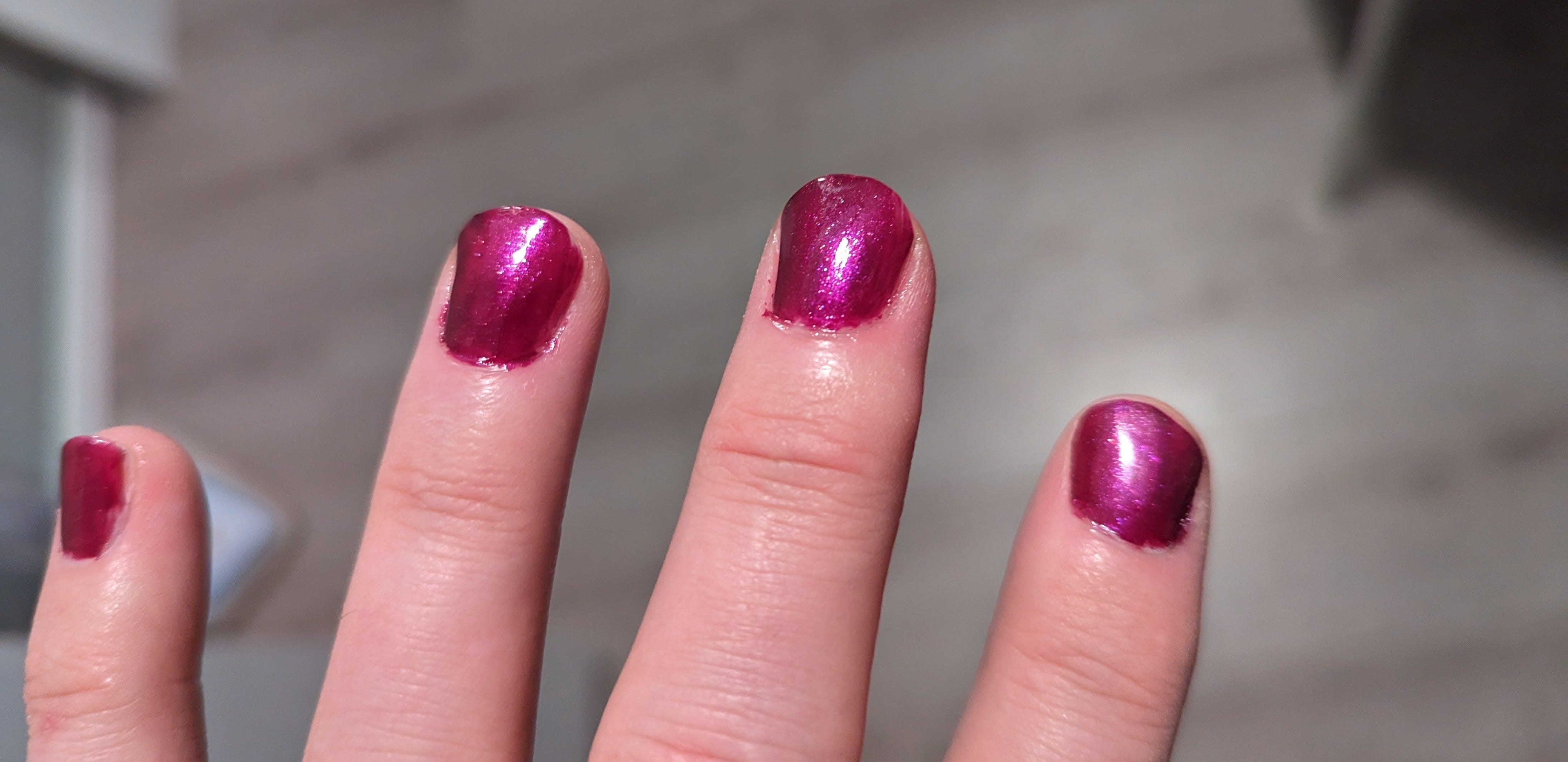
Practice your brush work to get each coat as even as possible with few strokes. You’ll have to find the right thickness. Too thin and the color is blotchy, even after two or three coats. Too thick and it will flake off.
I’ve gotten nice coverage with two coats, but you may want more. Some people advise adding four coats or more.
After your main color, this is where you can add the magic. My favorite overcoat is Fig Flash from Sally Hansen’s Insta-Dri (haha) collection. It’s a semi-transparent light purple glitter coat that adds depth to the color underneath. That’s what I’m wearing in the picture, over the Y’Orchid-ing I mentioned above. It transforms a nice, deep burgundy red into a scintillating wine purple.
Finally, don’t forget your top coat! I’m currently using Essie No Chips Ahead. It seems pretty effective, although I do a lot with my hands, so I get wear on the leading edge pretty quickly.
If you have more nail tips, leave a comment below!
This post was originally published to my Substack blog on September 7, 2023. This is the story all about howMy life got flipped, turned upside-downSo if you’d like to take … Continue reading My awakening
This post was originally published to my Substack blog on August 22, 2023.
I’m trans.
You mean you’re going to turn into a woman?
Not exactly. My internal sense of gender has always been feminine.
So why did you wait so long?
Because I didn’t know I was trans.
But you just said…I’m confused.
That makes two of us, hon.
When you realize you’re trans later in life, your mind lunges out in different directions, trying to make sense of it all. Am I a woman now? Was I always a woman? Why didn’t I see it before? Was this or that event a clue I should have seen?
However long it takes, the process of hatching is hard. You will look at the core of your being more closely than you ever have. You may wonder if you have two personalities. You may wonder who the real you is. You may wonder if there is a real you. You may ask yourself, “Is this my masculine face?” And you may ask yourself, “Is this my genuine voice?”
As the days go by, you may find yourself crying more in one week than you have in years. But at some point you will figure out who you really are. It may take a week, or a month. For some it may take years. But after you discover your authentic identity, one question may remain:
Who was I before?
I think about this question a lot. As I write this, it has been two weeks since I emerged from my existential uncertainty as a trans woman. I’m still equal parts terrified and excited–although I’m more joyous than either of those emotions. Every hour of every day, I celebrate who I am.
I’ve never done that before. After years of ups and downs, dealing with depression and constant change, I had settled into a comfortable pattern of content existence. I felt like I wasn’t a special, unique individual, just another person making his way through life. The egg metaphor is significant. I feel like my life began the week I hatched.
So what does that say about who I was before?
Near the end of my hatching week, I confided in a new friend that I wasn’t ready to lose my old self, to let him fade away. (Dammit, Mae! Your webcomic is so beautifully poignant!) I was terrified of losing the person I was in order to transform into the person I would become.
But I realized that I don’t have two wolves inside of me. I’m not losing any part of myself that matters. The man who lived his life, trying to be a good person (failing more than I’d like to admit, but still trying), was always me. She will always be me. She just wasn’t a man.
So who or what was I?
I keep asking this question, and the only answer I have is, I was me. My “actual” gender was questionable. I lived most of my life as a man, not as a woman, at least performatively. I had everybody fooled…including myself. But it’s not that simple.
Gender is not a hard-coded binary attribute. (Neither is biological sex, but that’s a whole article in itself.) My transition was eased somewhat because I’ve long recognized some of my feminine traits. It’s been over 15 years since I tried to get my beard lasered away. At that time, I was back in school (long story), and my best friend was a classmate who happened to be a lesbian. We got along fantastically well from day one, and I opened up and let her see the real me.
One thing she knew very well about me was that I was attracted to women, but also wanted to be friends with them (and had almost no interest in friendships with men). Because of this, she referred to me as “a lesbian trapped in a man’s skin.” In that way, she saw me better than I saw myself.
I’ve always had a strong feminine component to my personality, even when I ignored it, pushed it away, or hid it behind a mask of exaggerated masculinity. Does that mean I’ve always been a woman? I honestly don’t know. But the conclusion I’ve come to is,
It doesn’t matter!
I was me, and I am me. The person who was George is the person who is Violet. I’m just being more honest now, both with the world and with myself. Having a masculine body doesn’t make me less feminine. But having a feminine body will make me feel more complete. It will make me a more confident woman, fulfilling my deepest existential desire: to be one of the girls.
And, of course: more hair!
This post was originally published on my Substack blog on August 20, 2023.
Note: This article includes straightforward but non-explicit descriptions of kinky activities. It also mentions the word “sex” several times. You should be okay unless you’re too normal.
I’ve been socially transitioning for two weeks now. Officially, anyway. Looking back on the last couple of years, my interactions with the women in my life have been transitioning for quite a while. Dropping my “social shield” when talking to my friends was so liberating, it made me feel almost like one of the girls.
And despite the oh-so-subtle feminine affect I let show, no one thought I was weird. Everyone thought I was normal.
One of my coworkers used to get an artistic manicure every week or two. Her nails always looked fabulous. Every time I went to her office to talk about a project, I totally fan-girled over her nails. I hadn’t realized I was interested in nails because, after all, I was a man. But she talked about them with enthusiasm, as if my interest were completely normal.
When I met moved to Vancouver, I made a new best friend. She is so awesome*, and one of her awesome aspects is her taste in shoes. I never knew I had an interest in women’s shoes until I met her. I went completely gaga over several of her pairs, which are so darn cute. And her work boots…I was so disappointed they only come in a B width so I can’t commit my soles to them. She thought I was normal too.
Earlier this year, when I firmly committed to myself that I was not going back into the closet from which I was finally emerging, I dyed my hair bright purple. I was a little anxious when I went to work the next day, but the most dramatic reaction I got was “Hey! Your hair is purple!” When someone new comes into the building, they don’t react at all. To them, I’m perfectly normal.
“Normal is what everyone else is and you’re not.”
– Soran
When he said that, Malcolm McDowell’s character was trying to intimidate someone who looked different from everyone else. The deeper meaning is that we all have thoughts, feelings, and desires that we think are uniquely ours. We’re afraid to show them because we think they’re not normal. But if everyone shared their “abnormalities” at once, we’d probably find that they’re not as unique as we thought. In fact, they’re quite normal.
What’s that? Not you? You think I’d blush if I knew half of what you’re thinking? One of the best ways to get in touch with the normality of your weirdness is to join your local kink community. Yes. Those weirdos. Even if you’re not into stereotypical kinks like bondage and spanking, you will eventually find someone who shares your kink. Even if you enjoy having your toes painted green and slapped with a rubber band. Even if you enjoy sniffing other people’s knees. Even if you enjoy wearing white after Labour Day. And you’ll have so much fun, you’ll realize how normal we weirdos really are.
The truth is, no one is a carbon copy of anyone else, but at the same time, our unique quirks are similar enough to someone else’s unique quirks that we can all find a community. We all like things that we think other people think are strange, and we all try to fit in. To be normal. But guess what:
Normal does not exist.
Normal is an illusion created by our insecurities. It creates a wall between each of us and the rest of the world. It’s time to embrace weirdness. Your unique weirdness that, despite its uniqueness, will make someone somewhere say, “Hey! I can relate to that!”
Sex!
Did I clear the room? Did anyone who stayed for the kinky talk get scared by the mention of the critically important biological activity that allows life on Earth to continue?
Sex is so important for our survival, it always boggles my mind that it’s such a taboo subject. That’s why discussion of gender tends to be uncomfortable in some environments even though gender has nothing to do with sex.
Nothing? Not even a little bit? Not really. Who we are, who we’re most comfortable with, how we behave in certain groups, what we wear, and what we’re interested in have nothing to do with the ins and outs of furthering the species.
I could dive into a deeper explanation of the nature of gender, but someone else has already done it far better than I ever could. This would be a good time to pause reading this post and go read this other one.
Is everyone back? Great. She’s amazing, right?
Where was I…
Sex and gender get conflated because for most of the population, their gender corresponds to their assigned sex at birth in a way our society has come to accept as normal. Could any other way be normal? Could “normal” men wear dresses and pantyhose? Could “normal” women be fearsome warriors and lead armies? Could “normal” transgender people be accepted in society without so much as an eyeblink?
Of course, because all of those things have been the norm at various points in history in various societies.
The norms and taboos of our society are not a constant, unbending, fundamental foundation that would collapse our whole world if they shifted. On a broad time scale they’re a passing thought, a momentary lapse of reason. Attempting to make everyone conform to them is pointless because they’ll shift, if only slightly, in a single generation.
So embrace your uniqueness. And, yes, even your weirdness! The more authentically we all live, the more we will all feel…normal.
*Yes, I know you’re reading this, and I know you’re blushing, but you are awesome!

