One common thread in transfemme circles is someone posting a selfie that makes them feel dysphoric. The usual response is a bunch of people saying they don’t see a man in that pic.
We all know trans girls who we see as very feminine, people who we think it would be impossible for anyone to see as male. But it is possible because that person sees it. We all see it in ourselves at one time or another.
We spent a long time, sometimes decades, seeing our faces as male, whether or not we were conscious of the reason for our distress. I was over fifty when I realized I was trans. For five decades, I just thought I was a weird-looking, kind of ugly guy (but an ugly guy with nice blue eyes).
Hormone therapy often seems like magic with all of the changes that happen, but our face remains our face, no matter how much more feminine it becomes. Since we spent so long thinking of our faces as male, the similarities connect us with our pre-transition period, even if those similarities aren’t particularly masculine. I have lines around my eyes. That happens when you get older, and doesn’t have anything to do with gender, but it’s one of the features that gives me dysphoria.
At this point it starts to cross over from dysphoria to dysmorphia.
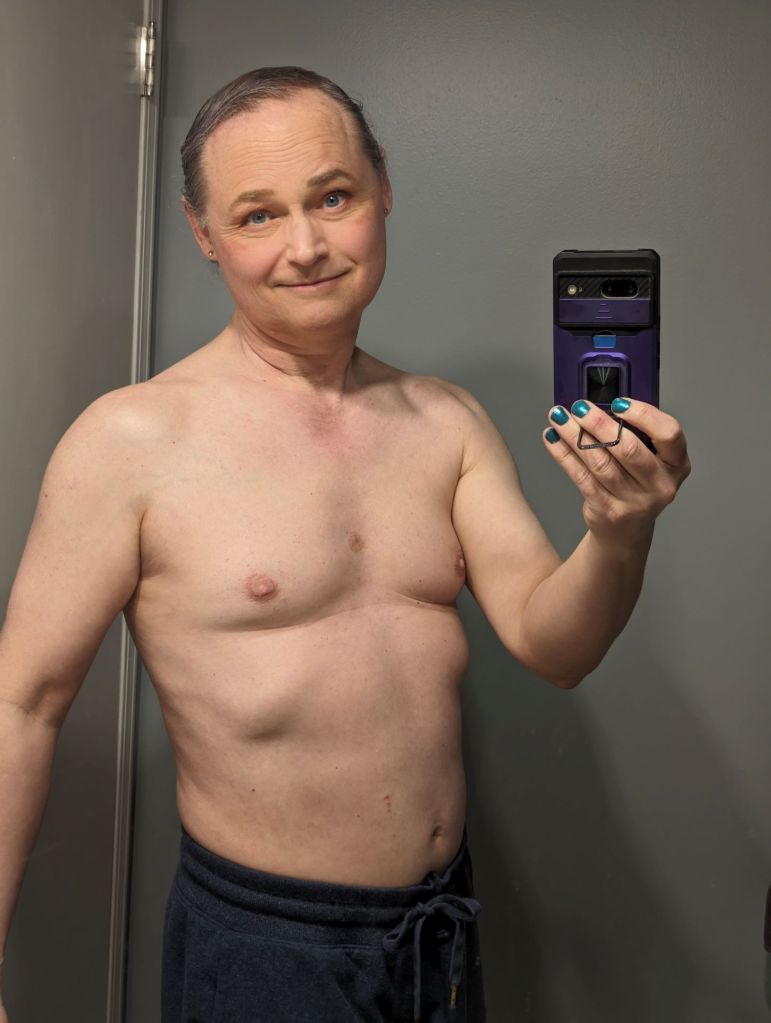
Ugh. Look at my masculine cheeks. And those manly shoulders. And that masculine chest.
I know some of you are thinking, “Are you shittin’ me, Violet? There is nothing manly in that picture!” But I still see it sometimes. Yes, even when I look at my tits, even though I’ve outgrown my smallest bra.
I’m not the most feminine girl on the block, but I know I’m not seeing myself one hundred percent accurately. My self-image is changing. Every day I see myself more clearly. But it takes time, and I’m enjoying the ride.
Content warning: This post includes pictures of a shirtless man and a topless woman, with the complication that they’re the same person.
Last Tuesday, Tilly Bridges posted her weekly blog article, Tilly’s Trans Tuesdays (Google Docs link). Her focus was dysphoria. Reading her article prompted me to write one of my own. As Tilly explains, there are many ways to feel dysphoria. Tilly’s dysphoria experience was quite different from how I felt–or didn’t feel.
My egg cracked (1) when I was fifty-three years old. Before that, I was somehow completely clueless that all of the feminine aspects of my personality, all of the stereotypically feminine interests I suppressed, and my lifelong desire to be one of the girls were trying to tell me that I was trans.
Trans people are fond of ironically saying, “There were no signs.” Despite the irony, it’s often the case that the signs are only visible to us in retrospect. When you’ve lived your entire life in a cave, when it’s the only thing you know, you don’t know it’s a cave. Only when you step out into the sun do you realize you’ve been living in the dark.
That was the case with me. I look back and see many signs. I mentally kick myself for not seeing them. But I can’t beat myself up for that because, clear as they are to me now, those signs were not visible from my perspective. They’re a kind of retroactive dysphoria.
So what were some of those invisible signs?
Facial dysmorphia
I never liked my face. I hated almost every picture of myself. When I looked in the mirror, I didn’t usually look myself in the eyes. When I did, I didn’t see anything there.
Over the years, people told me I was a good-looking man, but I never saw it. In the end, I kind of accepted the majority opinion, but I still didn’t really believe it. That’s what made my realization all the more dramatic. It was precipitated by a webcomic by Mae Dean shown on a blog post by Doc Impossible. The webcomic featured the following social media post:
See My Awakening for more detail on how the next week went for me.
As I started transitioning, my mental image of my face started to change. First it was my smile, which was new. I smiled quite often before transitioning, but the smile I developed last fall made it seem like nothing before was a real smile. The left side of my mouth was raised, occasionally joined by the right, but my eyes rarely joined the party. Since last August, my eyes have led my smile. The position of my lips doesn’t matter as much because my eyes are smiling.
Then came hormone replacement therapy: estradiol patches and a testosterone blocker. Before long, my face physically began to change, to soften. I started catching little glimpses of what I thought of as “her,” even if “he” still dominated my features. Then, on December 27, I looked in the mirror and saw myself. In my face. In my eyes. Since then, my facial dysphoria has faded. I still see little glimpses of “him,” but now, all I ever really see is me.
I can feel it in my facial expression. I don’t have my old wooden, guarded face. I smile by default.
In six months, I’ve taken more selfies than in my entire previous life.
It’s easy to see why.
August 12, 2023
March 12, 2024
Hair dysphoria
Hold on, back up a bit. This section says dysphoria, but the previous section said dysmorphia. What’s the difference? Many other people said my face was attractive, but I didn’t see it. That suggests I had an unrealistic mental image of my looks. I saw ugly when everyone else saw kind of cute. If you have a flawed (dys-) perspective of your appearance or shape (morphos), that’s dysmorphia. If you see something about yourself realistically, but you hate it, that’s dysphoria (literally, you can’t bear it).
So what was wrong with my hair?
When I was young, I didn’t think much about it. My parents told me when I needed a haircut and took me to get one. In university, I saw a lot of friends with longer hair, and decided I wanted that. But no matter what I did, with the help of the campus stylist, I couldn’t make it grow down. It would only grow up. Eventually, in my late twenties, I gave up and shaved it all off.
Fast forward twenty years. I was on my own after separating from my second wife. I started getting in touch with my feminine side. Part of that was realizing that if I ever wanted my hair to grow out, I’d better hurry up before it was gone. I had been slowly thinning on top, and by this point I had a small bald spot. As I let it grow out, I still wasn’t happy with it. It was too thin. But I persevered.
In the case of my hair, I experienced dysphoria that I never related to my desire to be more feminine.
Wait a sec. If I always had a desire to be feminine, how could I not know I might be trans? The short answer is, when I was young, I didn‘t even know the word, let alone what it meant. As time went on, I simply maintained my image of who I was–which, despite putting on a happy face and projecting an air of confidence, wasn’t the person I wanted to be. Unfortunately, the only image of who I really wanted to be was so ridiculously impossible to me, I never let the idea enter the front of my mind.
Body hair dysphoria
Nothing NSFW in this pic, just male pecs
I was looking at an old picture of myself the other day. I took that picture in 2017, after I had lost quite a bit of weight. This was long before I started shaving my body hair. It had always bugged me, but it was a part of me, and I didn’t think of getting rid of it. After all, guys didn’t shave their body hair; only women did. Just over a year before I discovered myself, I had a medical device for a day that required shaving several patches on my chest. After removing the electrodes, I decided I didn’t want to be patchy, so I shaved the rest of my chest hair. As I looked at myself in the mirror, I wondered why I hadn’t done that years ago. I immediately thought of the reason: deeply ingrained gender expectations. The next day I shaved my legs, and I’ve been shaving my body hair every week since then.
Oh no! Exposed female breasts!
As I started my transition, my body hair dysphoria increased. Every weekend, before my shaving ritual, I’d look at my body hair with revulsion, needing to get it off. If I saw a picture of a man with a hairy chest, I looked away. When I tentatively ventured onto dating apps, I swiped left on any profile with body hair or facial hair without reading further.
But when I looked at that old selfie the other day, I didn’t look away. For one thing, I couldn’t stop looking at the differences between it and my recent topless selfies. But it was more than that. I thought my body hair in that picture was attractive. I still wouldn’t want it back, but if I met someone with that amount of coverage, I probably wouldn’t turn away like I used to.
However, I do think I look much better clean-shaven.
Facial hair dysphoria
Facial hair is another story. And right now, it’s a happy story. After three full-face and one middle-face laser treatment, my visible facial hair is practically gone. The white hair is still there. There’s nothing laser treatment can do about that. But it’s invisible for most of the next day after I shave–a far cry from my former 10 AM shadow!
I always hated my beard. But I was a man, so it was part of me. I tried to grow a beard a few times, but each time I couldn’t stand it for more than a couple of weeks. Finally, in early 2007, I had had enough. I went for three laser treatments to try to get rid of it once and for all. I hated it. I wanted it gone. Unfortunately, laser technology at the time wasn’t very effective, and I couldn’t keep going back for more treatments. I resigned myself to having sandpaper on my face. But at least the laser sessions thinned it out enough that shaving wasn’t so painful anymore.
Denial of my interests
Boys like blue; girls like pink. Boys are interested in sports, cars, and being manly in the outdoors. Girls are interested in fashion, makeup, and making a good home for the children they definitely have to have.
Nowadays, we realize how ridiculous it is to have such strictly defined interests, separated by gender. Sort of. Well, some of us realize that. But if you go into a store, online or in the corporeal world, you’ll see clothes and toys separated by gender. These days, we like to think that we’re more enlightened than we were in past decades, but gender fortification (setting expectations for one’s perception of their gender) is still very strict.
So throughout my childhood, I played with cars, building toys, and other boyish interests, and made sure I didn’t even think about playing with dolls, brushing their hair, or even playing with the girls on my street. As a teenager, I was reluctant to join the choir because that was for girls. But I was glad that the choir teacher convinced me because singing was a lot of fun, even more so than playing in the band, and my vocal development paved the way for my voice transition four decades later.
In my adult life, I took on the role I was required to play, trying to be interested in team sports, but failing to gain any skill at playing them, continuing to wear “boy” colors, and never expressing my strong interest in hairstyles, which had become a kink–a term I only became aware of in my late thirties, and only embraced in my forties.
It wasn’t until my final marital separation that I finally allowed myself the luxury of exploring my interests, including shoes, fashion, makeup, and hair. I enjoyed exploring my interests in an atmosphere where it was accepted. That was probably the most significant factor that led me to the point where I was ready to accept my egg (1).
Since starting my transition, not only do I enthusiastically explore my interests, I don’t feel like I need to hide them. Finally, they feel perfectly normal.
The overall effect
Even though I never consciously experienced dysphoria, realizing and accepting my identity was the most significant emotional release in my life. It was as if I used to wear a heavy iron breastplate, but never realized it was there, or that I could simply unbuckle it and let it fall off. It’s like Plato’s cave allegory; I had only seen shadows of my personal reality–then suddenly I emerged and saw the real world.
In my old life, I felt empty. I tried filling my reality with identities borrowed from others, especially my second wife, who I met after a series of events left me with a huge internal vacuum. I also tied my identity to my work. Of course, I never realized any of that, no matter how desperately I felt it. Since I began my transition, I’ve been filling in the blanks from inside myself. I feel like I’m good enough. Good enough to exist on my own without relying on someone else to make my life complete. Good enough to be happy with who I am without feeling like I have to strive to be someone better. Good enough to be there for my friends when they need me, and not feel like I’m burdening them by asking for support when I need it. Good enough to love, and be loved.
Good enough to really believe that I deserve this wonderful new life.
(1) Receiving an egg, cracking, and hatching form a common metaphor for trans people discovering themselves.
One of the most affirming things I’ve done recently (aside from talking to my best friend; nothing beats that) is try FaceApp.
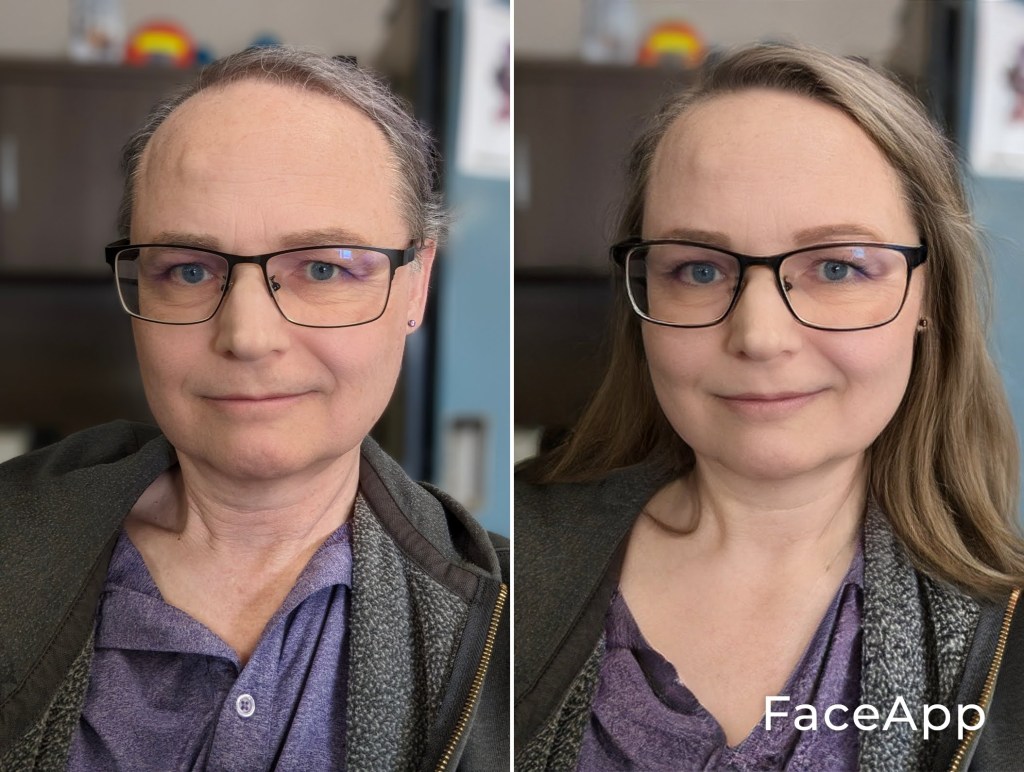
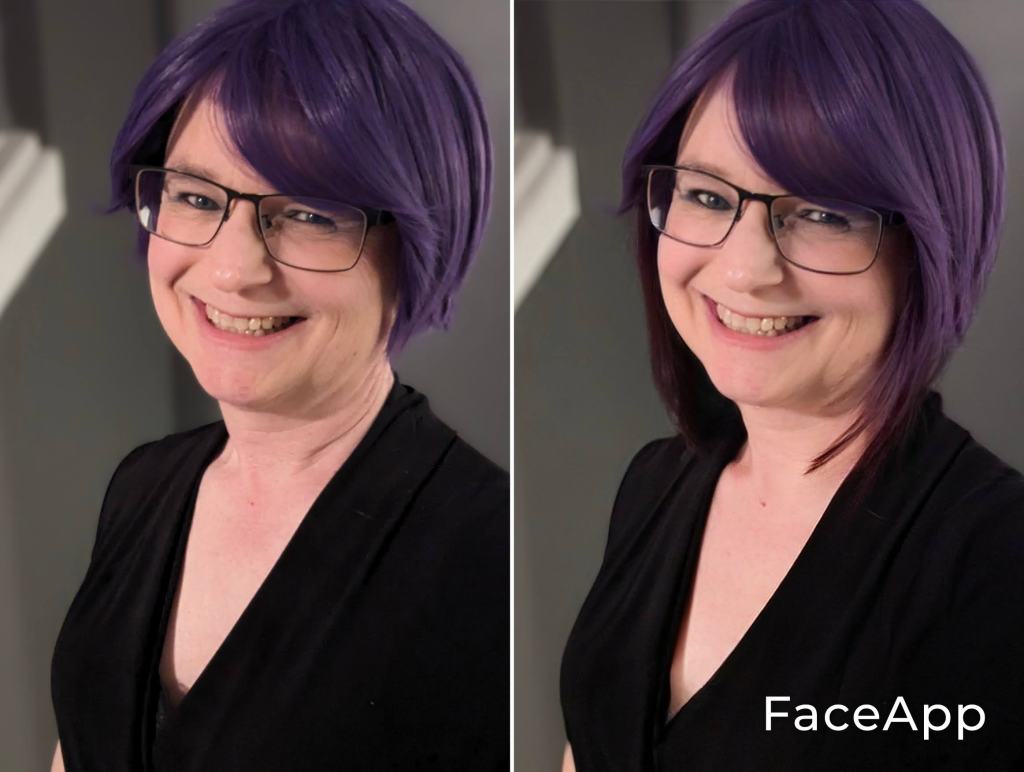
I was feeling particularly boy-mode-ish the other day. Near the start of my transition, I used a locally installed AI app to feminize my appearance, but as someone told me recently, I’ve exceeded that caricature already. But, feeling particularly dysphoric about my face the other day, I had to know how FaceApp would initially identify me. I uploaded one of my favorite recent selfies. It identified me as male, of course. But the feminized pic wasn’t much different.
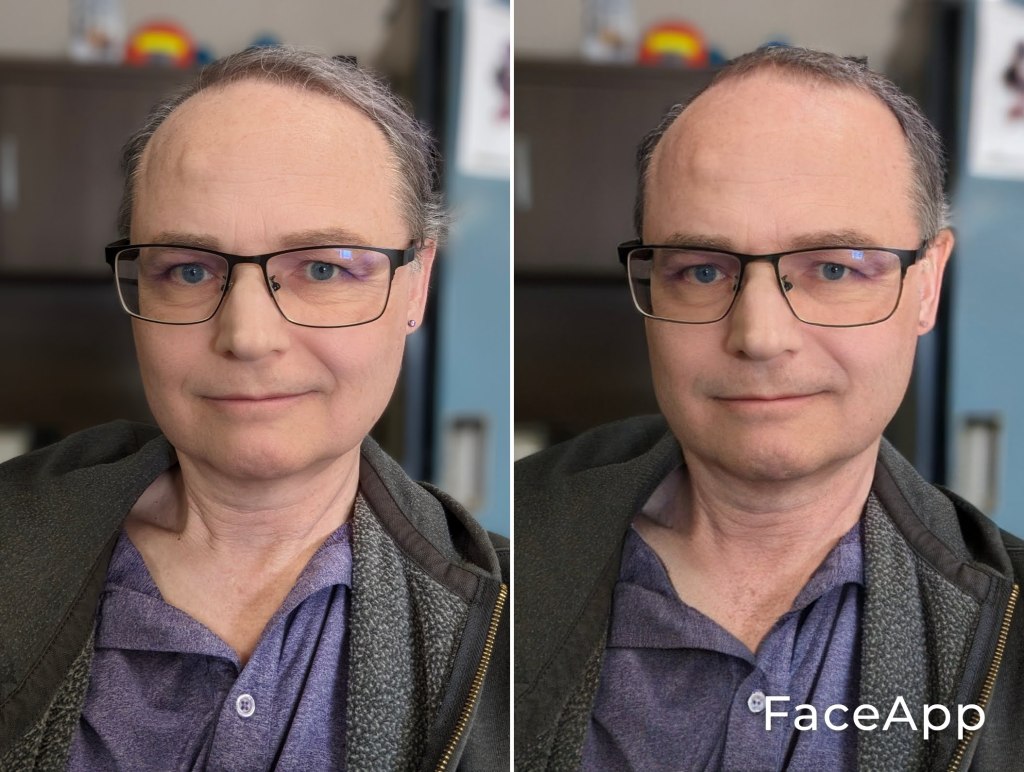
I tapped the option to make my pic more masculine. Once again, not much difference.
Then I selected a pic with my wig and pantsuit. If the system identified this pic as male, that would confirm my facial dysphoria. But it identified me as female. I hit the option to make me more feminine. Hardly any difference.
I uploaded a dozen more photos, most of which I didn’t save. FaceApp identified me as female just less than half the time. Even a picture in which I thought the light made my face particularly angular, with makeup but no wig, was identified as female.
My face is pretty much gender neutral. I’m the best of both worlds, baby!
While putting this article together, I looked at these pictures in my Google Photos album. Google Photos automatically detects pictures of you and prompts you to add other faces in the picture. If you save a collage of multiple pictures of you, it will only identify one, assuming that the others are different people.
In the first picture in this post, it recognized the feminized version as me and prompted me to identify the face on the left. When I viewed the masculinized version of the same pic, it identified that version as me, and, once again, asked me to identify who the “other” person on the left might be.
Even mighty Google, with all of its invasively collected image data, couldn’t tell the original from the modified version, getting it wrong four out of five times. The only comparison it identified correctly was the one below, and no kidding; I can’t even dream of having that hair!
Labels have power far beyond their original definition. They control us if we let them. But the name is not the thing itself. In fact, some of the things we apply powerful, pervasive labels to…do not actually exist.
I’ve been thinking about gender again. Someone happened to include “If you want to be a [gender], you can just be a [gender]” in an article earlier, which planted the … Continue reading If you want to be…or not to be
One of the coping suggestions in SGW this morning reminded me of something that happened to me on Saturday night. That was the day I went to the opera. It was a day to remember, in more ways than I expected.
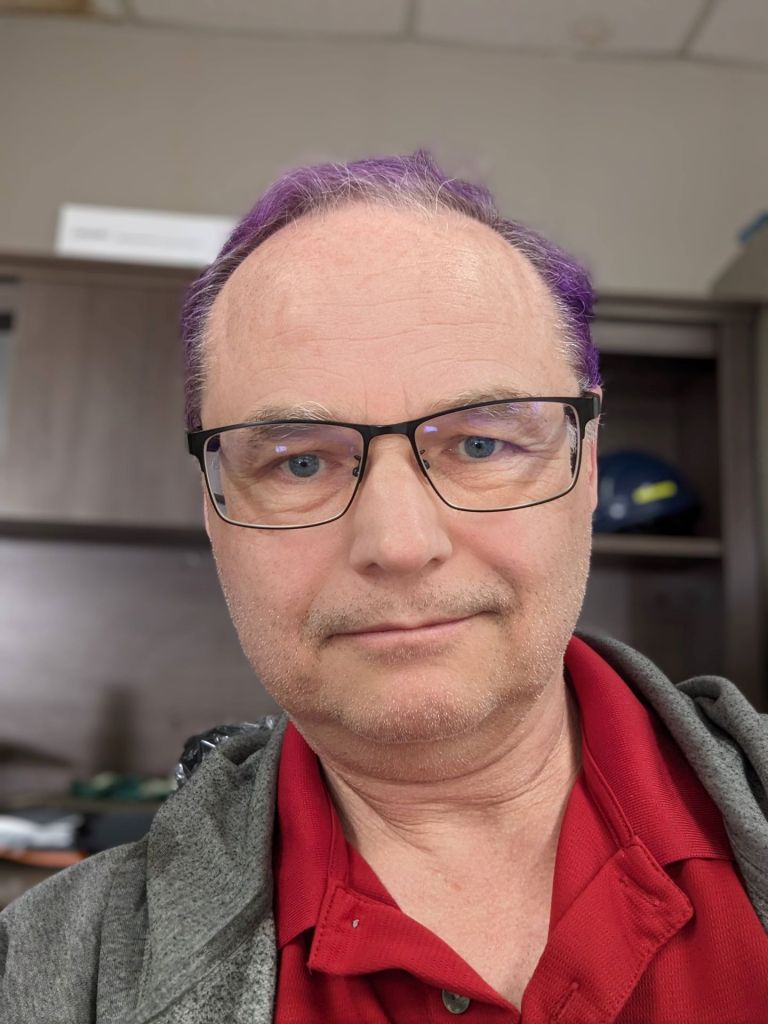
I was talking to my best friend on the weekend.(1) We were talking about smiling, and how it comes through when you really feel it. I sent her this picture, which was taken on April 16, 2023.
I took that picture shortly after dying my hair purple for the first time, three and a half months before my awakening.(2) That’s about as brightly as I ever smiled in my selfies before I transitioned. Just now I was looking for a selfie taken just before I transitioned, but I don’t have one. The closest one I have was taken in May.
I never used to take a lot of pictures of myself. I created a folder for my selfies in late November because I had started taking a lot more. I went back two years to find old selfies. My new folder contained 19 selfies taken in the two years before I transitioned, and 91 taken in the four months since. As of today (January 29), that folder has 227 pictures in it.
This is a common pattern among transgender people. When you start loving yourself, you take more selfies. A lot more. This one is my favorite:
This picture was taken on January 6 by the person who had just pierced my ears. In 54 years, this was the first time I had gotten a piercing. I was happy. My piercing artist was very affirming. She had just said something that made me smile, and she took three pictures in short succession.
For days, I couldn’t stop looking at this picture. I had smiled before transitioning, of course. I had been happy once in a while. I had smiled specifically for pictures. I smiled when my son was born, and when I got married. But I had never smiled like I did in this picture.
Immediately after leaving the studio, I sent this pic to a bunch of friends. I received replies throughout the day. Everyone said I looked great. I looked so happy. My sister said she had never seen that smile before.
When I got home, I started changing the profile pictures on all of my online accounts to this selfie. I had never loved a picture of myself so much. Before transitioning, I had never loved a picture of myself at all.
This picture is me.
So who was in the previous picture? I looked at the first picture again this morning, and I didn’t recognize myself. It’s me, but not me.
At the most fundamental level, of course I’m the same person. I’ve retained a lot of my thought processes and some of my behavior patterns. But I feel different. I express myself differently. I interact with others differently. And I look different. Part of that is three months of hormone treatment, but more of it results from how I feel about myself since I figured out who I am. Before transitioning, I didn’t look in the mirror much. When I did, I was looking at something specific, not at my face overall. Now I look into the mirror and I see myself.
Look at both pictures again. They’re not the same person. The first picture is a shell I used to hide behind. Me, but not me. The second picture is me.
(1) With this friend, that’s like saying the sky is blue, water is wet, etc., but I have to set the scene for this paragraph.
This post was originally published on my Substack blog on November 6, 2023. This morning, Doc Impossible posted an article in Stained Glass Woman that focused on the concept of othering, and … Continue reading Just an “other” one









 I Am Violet