How does gender affirming bottom surgery work? Where do they get the new parts, and how do they put them on? This is a simple guide to bottom surgery for trans women and men.

How does gender affirming bottom surgery work? Where do they get the new parts, and how do they put them on? This is a simple guide to bottom surgery for trans women and men.
Content notice: Contains joyful profanity.
It’s been one year since my life changed completely. Since it really started. On August 2, 2023, I was sitting at work, scrolling through Mastodon, when I saw a blog post by Doc Impossible that looked interesting. After clicking through Substack’s landing page, I ended up on her homepage, rather than the post I intended to read, so I decided to start at the beginning. Or close to the beginning. The first post I read was Part One: A Webcomic. I describe what happened next in great detail in My Awakening.
Since then, so much has changed. I met my best friend at the end of September. I describe why she’s such an amazing friend in 2023: The Year My Life Began. In the ten months we’ve known each other, we’ve become even closer, and she’s still the best friend I’ve ever had.

In October, I started hormone replacement therapy (HRT). In December, I looked in the mirror and actually saw my true self. For years, I didn’t like mirrors because all I saw was a weird-looking person, but now I smile every time I see my reflection.
In January, I came out at work and started dressing in more feminine clothes. In February, I wore my first dress, and looked absolutely elegant. In March, I started wearing a bra to work every day because my boobs were obvious under my shirt. In May, I started wearing a wig every day.
Since then, I’ve made more new friends who I talk to every day. I’ve become a very outgoing, social person. I frequently go out for dinner with a few local groups, and even go to parties. I never imagined I’d be this kind of person, although I always envied gregarious people. I used to sit at home all weekend, with the consolation that I wasn’t spending money by going into town. Now, if I have even one day on the weekend with nowhere to go, I feel anxious that I need to spend time with people.

I’ve developed my own makeup style, which gets compliments everywhere. I switch between several wigs, which also get frequent compliments. Some people even think my purple wig is my real hair!
I feel younger than I have in years. And apparently I look younger. I met someone several months ago who thought I was younger than he is. He’s thirty-eight! (And apparently nearsighted.) It’s fitting that someone would put me at that age, though; that was the age when I came closest to cracking my egg before retreating into the cave for another fifteen years.
I also feel healthier than I ever have. Shortly after starting my transition, I stopped eating meat at my best friend’s recommendation. My diet and my hormone regimen have both rejuvenated me. Before starting HRT, other trans women warned me that I’d probably gain weight. Instead, I lost a few pounds. Not stress eating is another part of my improved diet!
Last Friday, I invited my friends out for dinner to celebrate my egg crack anniversary. We went to a vegetarian restaurant. We talked and laughed all evening. I thanked the universe for how lucky I am to be where I am today—not to mention how good I look compared to a year ago! I wore a new dress and a new wig, which my friends loved. After dinner, I went to the bathroom and caught a glimpse of myself in the mirror. Then I stared at my reflection. “Holy fuck!” I thought. “I look cute!” I took the second picture below before driving home. I took the first picture last August.
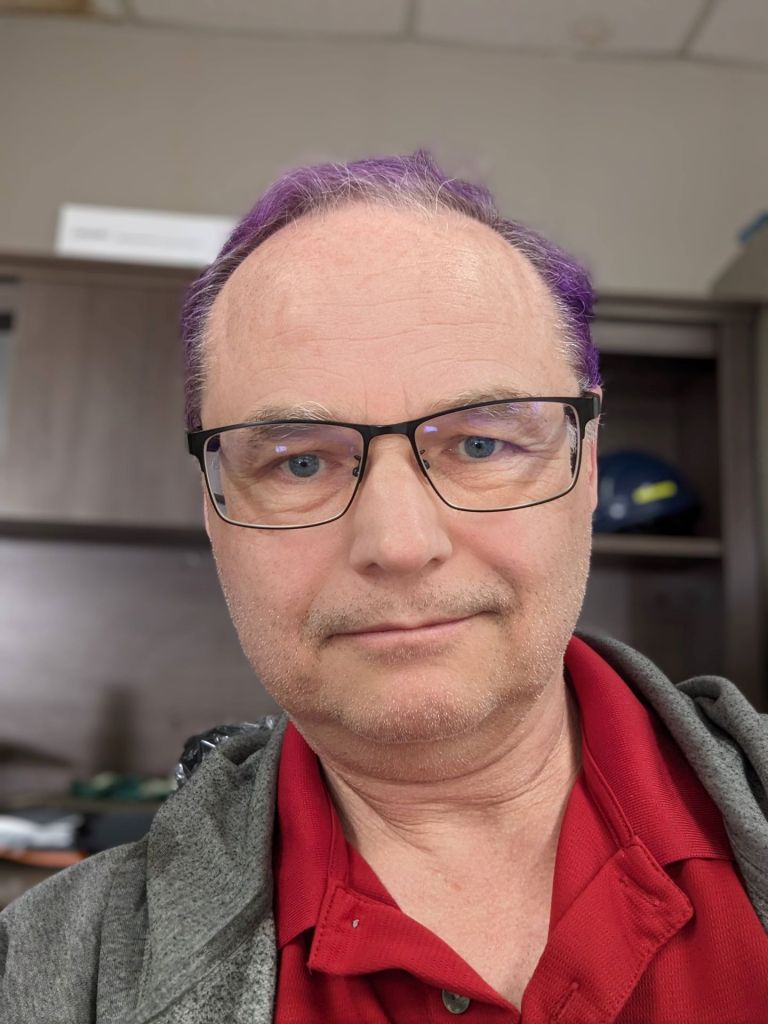

That’s a one year comparison. I can’t believe I used to look like that.
One year. Just twelve months, but it feels like I’ve lived more than I did in the previous twelve years.

I’m a nonbinary trans woman. How can I be both? Read on to find out…and get a catchy tune stuck in the middle of your brain.
Content warning: This post includes pictures of a shirtless man and a topless woman, with the complication that they’re the same person.
Last Tuesday, Tilly Bridges posted her weekly blog article, Tilly’s Trans Tuesdays (Google Docs link). Her focus was dysphoria. Reading her article prompted me to write one of my own. As Tilly explains, there are many ways to feel dysphoria. Tilly’s dysphoria experience was quite different from how I felt–or didn’t feel.
My egg cracked (1) when I was fifty-three years old. Before that, I was somehow completely clueless that all of the feminine aspects of my personality, all of the stereotypically feminine interests I suppressed, and my lifelong desire to be one of the girls were trying to tell me that I was trans.
Trans people are fond of ironically saying, “There were no signs.” Despite the irony, it’s often the case that the signs are only visible to us in retrospect. When you’ve lived your entire life in a cave, when it’s the only thing you know, you don’t know it’s a cave. Only when you step out into the sun do you realize you’ve been living in the dark.
That was the case with me. I look back and see many signs. I mentally kick myself for not seeing them. But I can’t beat myself up for that because, clear as they are to me now, those signs were not visible from my perspective. They’re a kind of retroactive dysphoria.
So what were some of those invisible signs?
I never liked my face. I hated almost every picture of myself. When I looked in the mirror, I didn’t usually look myself in the eyes. When I did, I didn’t see anything there.
Over the years, people told me I was a good-looking man, but I never saw it. In the end, I kind of accepted the majority opinion, but I still didn’t really believe it. That’s what made my realization all the more dramatic. It was precipitated by a webcomic by Mae Dean shown on a blog post by Doc Impossible. The webcomic featured the following social media post:

See My Awakening for more detail on how the next week went for me.
As I started transitioning, my mental image of my face started to change. First it was my smile, which was new. I smiled quite often before transitioning, but the smile I developed last fall made it seem like nothing before was a real smile. The left side of my mouth was raised, occasionally joined by the right, but my eyes rarely joined the party. Since last August, my eyes have led my smile. The position of my lips doesn’t matter as much because my eyes are smiling.
Then came hormone replacement therapy: estradiol patches and a testosterone blocker. Before long, my face physically began to change, to soften. I started catching little glimpses of what I thought of as “her,” even if “he” still dominated my features. Then, on December 27, I looked in the mirror and saw myself. In my face. In my eyes. Since then, my facial dysphoria has faded. I still see little glimpses of “him,” but now, all I ever really see is me.
I can feel it in my facial expression. I don’t have my old wooden, guarded face. I smile by default.
In six months, I’ve taken more selfies than in my entire previous life.
It’s easy to see why.

Hold on, back up a bit. This section says dysphoria, but the previous section said dysmorphia. What’s the difference? Many other people said my face was attractive, but I didn’t see it. That suggests I had an unrealistic mental image of my looks. I saw ugly when everyone else saw kind of cute. If you have a flawed (dys-) perspective of your appearance or shape (morphos), that’s dysmorphia. If you see something about yourself realistically, but you hate it, that’s dysphoria (literally, you can’t bear it).
So what was wrong with my hair?
When I was young, I didn’t think much about it. My parents told me when I needed a haircut and took me to get one. In university, I saw a lot of friends with longer hair, and decided I wanted that. But no matter what I did, with the help of the campus stylist, I couldn’t make it grow down. It would only grow up. Eventually, in my late twenties, I gave up and shaved it all off.
Fast forward twenty years. I was on my own after separating from my second wife. I started getting in touch with my feminine side. Part of that was realizing that if I ever wanted my hair to grow out, I’d better hurry up before it was gone. I had been slowly thinning on top, and by this point I had a small bald spot. As I let it grow out, I still wasn’t happy with it. It was too thin. But I persevered.
In the case of my hair, I experienced dysphoria that I never related to my desire to be more feminine.
Wait a sec. If I always had a desire to be feminine, how could I not know I might be trans? The short answer is, when I was young, I didn‘t even know the word, let alone what it meant. As time went on, I simply maintained my image of who I was–which, despite putting on a happy face and projecting an air of confidence, wasn’t the person I wanted to be. Unfortunately, the only image of who I really wanted to be was so ridiculously impossible to me, I never let the idea enter the front of my mind.

I was looking at an old picture of myself the other day. I took that picture in 2017, after I had lost quite a bit of weight. This was long before I started shaving my body hair. It had always bugged me, but it was a part of me, and I didn’t think of getting rid of it. After all, guys didn’t shave their body hair; only women did. Just over a year before I discovered myself, I had a medical device for a day that required shaving several patches on my chest. After removing the electrodes, I decided I didn’t want to be patchy, so I shaved the rest of my chest hair. As I looked at myself in the mirror, I wondered why I hadn’t done that years ago. I immediately thought of the reason: deeply ingrained gender expectations. The next day I shaved my legs, and I’ve been shaving my body hair every week since then.
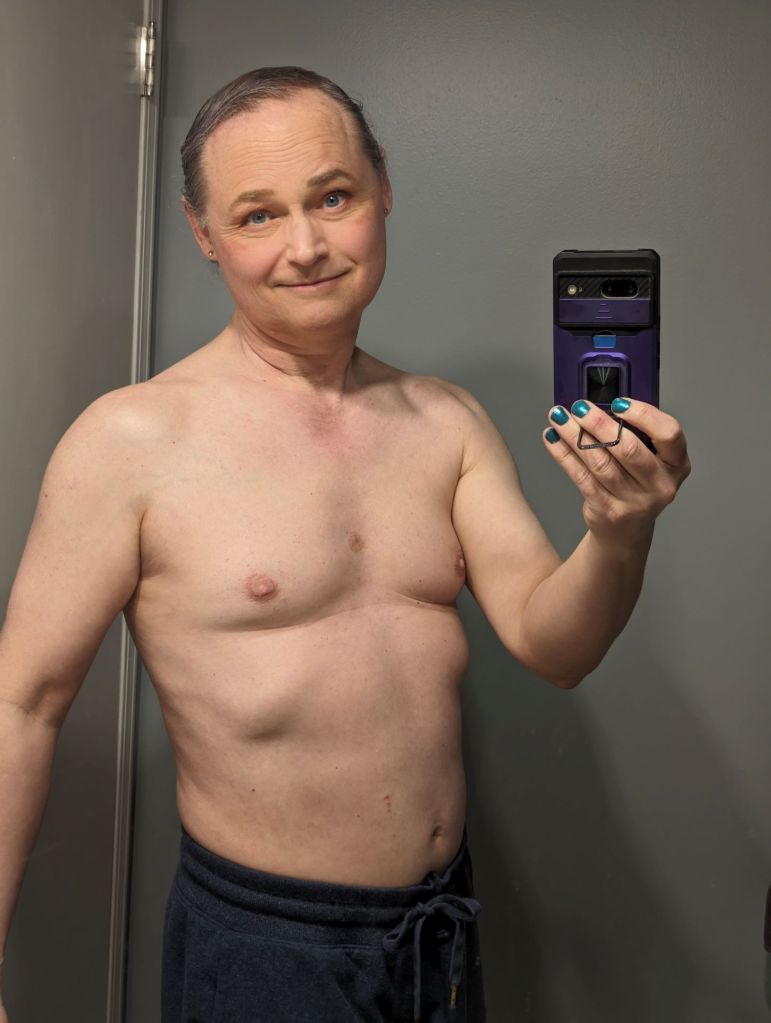
As I started my transition, my body hair dysphoria increased. Every weekend, before my shaving ritual, I’d look at my body hair with revulsion, needing to get it off. If I saw a picture of a man with a hairy chest, I looked away. When I tentatively ventured onto dating apps, I swiped left on any profile with body hair or facial hair without reading further.
But when I looked at that old selfie the other day, I didn’t look away. For one thing, I couldn’t stop looking at the differences between it and my recent topless selfies. But it was more than that. I thought my body hair in that picture was attractive. I still wouldn’t want it back, but if I met someone with that amount of coverage, I probably wouldn’t turn away like I used to.
However, I do think I look much better clean-shaven.
Facial hair is another story. And right now, it’s a happy story. After three full-face and one middle-face laser treatment, my visible facial hair is practically gone. The white hair is still there. There’s nothing laser treatment can do about that. But it’s invisible for most of the next day after I shave–a far cry from my former 10 AM shadow!
I always hated my beard. But I was a man, so it was part of me. I tried to grow a beard a few times, but each time I couldn’t stand it for more than a couple of weeks. Finally, in early 2007, I had had enough. I went for three laser treatments to try to get rid of it once and for all. I hated it. I wanted it gone. Unfortunately, laser technology at the time wasn’t very effective, and I couldn’t keep going back for more treatments. I resigned myself to having sandpaper on my face. But at least the laser sessions thinned it out enough that shaving wasn’t so painful anymore.
Boys like blue; girls like pink. Boys are interested in sports, cars, and being manly in the outdoors. Girls are interested in fashion, makeup, and making a good home for the children they definitely have to have.
Nowadays, we realize how ridiculous it is to have such strictly defined interests, separated by gender. Sort of. Well, some of us realize that. But if you go into a store, online or in the corporeal world, you’ll see clothes and toys separated by gender. These days, we like to think that we’re more enlightened than we were in past decades, but gender fortification (setting expectations for one’s perception of their gender) is still very strict.
So throughout my childhood, I played with cars, building toys, and other boyish interests, and made sure I didn’t even think about playing with dolls, brushing their hair, or even playing with the girls on my street. As a teenager, I was reluctant to join the choir because that was for girls. But I was glad that the choir teacher convinced me because singing was a lot of fun, even more so than playing in the band, and my vocal development paved the way for my voice transition four decades later.
In my adult life, I took on the role I was required to play, trying to be interested in team sports, but failing to gain any skill at playing them, continuing to wear “boy” colors, and never expressing my strong interest in hairstyles, which had become a kink–a term I only became aware of in my late thirties, and only embraced in my forties.
It wasn’t until my final marital separation that I finally allowed myself the luxury of exploring my interests, including shoes, fashion, makeup, and hair. I enjoyed exploring my interests in an atmosphere where it was accepted. That was probably the most significant factor that led me to the point where I was ready to accept my egg (1).
Since starting my transition, not only do I enthusiastically explore my interests, I don’t feel like I need to hide them. Finally, they feel perfectly normal.
Even though I never consciously experienced dysphoria, realizing and accepting my identity was the most significant emotional release in my life. It was as if I used to wear a heavy iron breastplate, but never realized it was there, or that I could simply unbuckle it and let it fall off. It’s like Plato’s cave allegory; I had only seen shadows of my personal reality–then suddenly I emerged and saw the real world.
In my old life, I felt empty. I tried filling my reality with identities borrowed from others, especially my second wife, who I met after a series of events left me with a huge internal vacuum. I also tied my identity to my work. Of course, I never realized any of that, no matter how desperately I felt it. Since I began my transition, I’ve been filling in the blanks from inside myself. I feel like I’m good enough. Good enough to exist on my own without relying on someone else to make my life complete. Good enough to be happy with who I am without feeling like I have to strive to be someone better. Good enough to be there for my friends when they need me, and not feel like I’m burdening them by asking for support when I need it. Good enough to love, and be loved.
Good enough to really believe that I deserve this wonderful new life.
(1) Receiving an egg, cracking, and hatching form a common metaphor for trans people discovering themselves.

Insights into dysphoria. It doesn’t always feel like a crushing weight. Most of the time you don’t even recognize it for what it is.

This post was originally published on my Substack blog on November 20, 2023. Almost a year before my egg cracked, I started wearing makeup. Or at least trying to. Over … Continue reading Putting on my best face
This post was originally published on my Substack blog on October 21, 2023.
When I came out to my mom a few weeks ago, she had some questions. She’s very analytically-minded, so they were insightful questions. One of them was about gender expression. Why do trans and gender diverse people put so much emphasis on feminine expression? My mom rarely wears anything more feminine than jeans and a t-shirt, and rarely wears makeup, but it doesn’t make her feel less like a woman.
I know the reason I want to express my identity clearly is because I spent so long expressing myself as a gender that didn’t suit who I am inside. And not just expression; all of this “terrible T” did a great job of giving me a masculine body, and is starting to rob me of my hair. Now that I know who I am, I feel like I need to turn the tables.
Not all at once; I’m still only part way out of my sturdy, comfortable closet. But I started dying my hair purple a few months before I was consciously aware of what I was trying to express. I wear makeup when I go out with my friends (another habit I’ve had since before I was conscious that I was transitioning). And I’ve recently started painting my nails.
Out of all of the forms of expression I’ve adopted so far, my nails are the most satisfying. I don’t have enough hair to do much with it, and I don’t have the shape for feminine clothes. My makeup game is improving, but my face still isn’t quite right. But my nails are a small victory.
I compulsively bit my nails for decades. I tried to kick the habit many times, but always started again, unconsciously in most cases. If you’ve ever tried to quit a bad habit like smoking, imagine if you had cigarettes constantly attached to your fingertips. You don’t need to take any action besides raising your hand to your face. So when I first applied clear nail polish, it was mainly because I wanted a stealthy form of gender expression, but secondarily because I thought maybe it would discourage me from biting my nails.
I don’t know whether it was the polish or my egg hatching, but I haven’t bitten one nail since.
For anyone who is just getting started, nails are one form of expression you can get the hang of fairly easily. Here’s what I’ve learned so far.
With some polish, you can paint one coat on your unprepared nails, let it dry, and go on your way. But it won’t last very long, and you won’t have a smooth finish. I always apply multiple coats.
Before I paint my nails, I prepare them. First, I use nail polish remover to completely remove the previous polish. Then I use a coarse file to make sure the upper surface of my nails is smooth. After a few times, you won’t need much coarse filing. Then I use a fine buffing block to smooth out the surface. Finally, following a tip from a helpful employee at Sally Beauty in Edmonton, I give each nail a swipe with acetone-based nail polish remover to get rid of any dust and dehydrate the nail surface.
Next comes the base coat. Some friends recommended Essie, so I bought their Strong Start base coat. You just need a thin coat to protect the nail and help the next coat stick.
After applying the base coat, your next step is to wait.
Then, when you think it’s time to apply the next coat, wait a little longer. Even if your polish is marketed as “Insta-dry,” well, “insta” must mean something completely different in marketing speak.
You can speed up drying with a fan, but I’ve found I still have to wait a minimum of two minutes to ensure that the next coat covers the previous one instead of trying to blend into it.
The color coats require some practice. The tutorials I’ve seen recommend covering each nail with no more than three strokes. Unfortunately, this isn’t always easy. The color I’m wearing right now is Y’Orchid-ing from Finger Paints’ Naturalism collection. I love the color, but the brush is so tiny it takes at least five strokes to cover my thumbnails. Essie and Sally Hansen both have much better brushes.
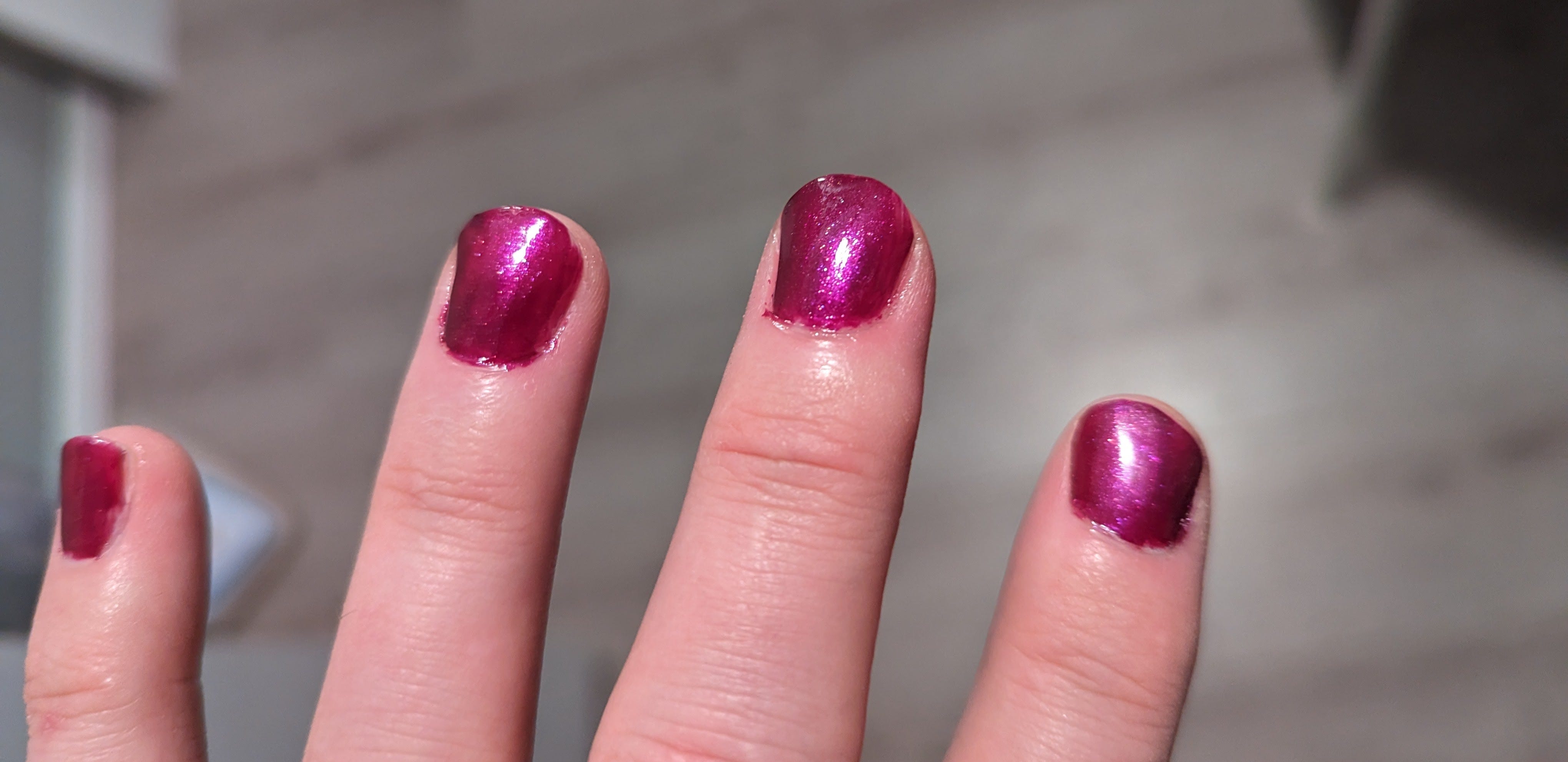
Practice your brush work to get each coat as even as possible with few strokes. You’ll have to find the right thickness. Too thin and the color is blotchy, even after two or three coats. Too thick and it will flake off.
I’ve gotten nice coverage with two coats, but you may want more. Some people advise adding four coats or more.
After your main color, this is where you can add the magic. My favorite overcoat is Fig Flash from Sally Hansen’s Insta-Dri (haha) collection. It’s a semi-transparent light purple glitter coat that adds depth to the color underneath. That’s what I’m wearing in the picture, over the Y’Orchid-ing I mentioned above. It transforms a nice, deep burgundy red into a scintillating wine purple.
Finally, don’t forget your top coat! I’m currently using Essie No Chips Ahead. It seems pretty effective, although I do a lot with my hands, so I get wear on the leading edge pretty quickly.
If you have more nail tips, leave a comment below!
 I Am Violet